
The Home Accessibility Tax Credit: Which Bathroom and Entry Renovations Qualify
Updated · 7 min read · By Gilbert Brothers
In this guide
The short answer
The Home Accessibility Tax Credit is a federal credit for a lasting renovation that lets a qualifying person get into, move around or use their own home, or that lowers their risk of harm there. A qualifying person is 65 or older at the end of the year, or eligible for the disability tax credit. CRA allows up to $20,000 of expenses a year, and the Income Tax Act sets the credit at the lowest federal rate for the year: 14.5% for 2025 and 14% for 2026 and later. It is non-refundable. This is not tax advice: ask an accountant.
What follows is what the Canada Revenue Agency (CRA) and the Income Tax Act say, as of October 2026. CRA's page for line 31285 shows tax year 2025. The rules and the rate can change from year to year, so read CRA's page for the year your work is done. The credit is claimed on a tax return by the qualifying individual or an eligible individual.
What the credit is worth
The credit is non-refundable: it reduces the tax you owe, down to zero at most (Finance Canada, June 2026).
The amount comes from the Act, because CRA's page does not print a rate. The Act multiplies the lesser of $20,000 and your qualifying expenses by "the appropriate percentage" for the year (section 118.041), which is the lowest federal rate for that year. Parliament set it at 14.5% for 2025 and 14% for 2026 and later years (S.C. 2026, c. 2, s. 2).
| Tax year | Lowest federal rate | Credit on $20,000 at that rate |
|---|---|---|
| 2025 | 14.5% | $2,900 |
| 2026 and later | 14% | $2,800 |
You may see $3,000 on older pages. That is 15% of $20,000, and 15% was the rate before it was lowered.
Finance Canada also describes a temporary Top-Up Tax Credit for the 2025 to 2030 tax years. It effectively keeps the 15% rate on non-refundable credit amounts above the first tax bracket threshold ($58,523 in 2026). It is for people whose taxable income and credit amounts both exceed that threshold. Finance Canada calls these very rare cases and estimates that less than 0.3% of filers are in them. Ask an accountant whether it applies to you.
Here is a made-up example. Say work finishes in 2026 and an accountant agrees $18,000 of the costs are directly attributable to a qualifying renovation. At 14%, the credit is $2,520. If $26,000 qualified, the $20,000 limit would apply: $2,800.
CRA says the expenses must be for work performed and goods acquired in the tax year. Work done in 2026 belongs on the 2026 return.
Who can claim it
CRA says you can claim if you are a qualifying individual, or an eligible individual claiming for one, and you had eligible expenses for a qualifying renovation to an eligible dwelling.
- Qualifying individual. Someone eligible for the disability tax credit at any time in the year, or aged 65 or older at the end of the year.
- Eligible individual. A spouse or common-law partner of the qualifying individual, or certain relatives who have claimed, or could have claimed, a dependant or caregiver amount for that person. CRA's wording has several conditions, so ask an accountant whether you fit.
- Eligible dwelling. A housing unit in Canada owned, jointly or otherwise, by the qualifying individual who ordinarily lives there. It can also be owned by the eligible individual, who lives there with the qualifying individual. Land up to half a hectare (1.24 acres) generally counts as part of it.
- Rental use. If you earn business or rental income from part of the home, CRA says you can claim only for the personal-use areas.
The $20,000 limit is per year. CRA says that when there is more than one qualifying individual for an eligible dwelling, the total cannot be more than $20,000 for the dwelling. The claim can be split among the people entitled to make it, and if they cannot agree, CRA decides the amounts.
Which bathroom and entry changes fit the tests
CRA says a qualifying renovation is "of an enduring nature and is integral to the eligible dwelling (including the land that forms part of the eligible dwelling)." It must also do one of two things:
- allow the qualifying individual to gain access to, or be mobile or functional within, the dwelling
- reduce the risk of harm to the qualifying individual within the dwelling or in gaining access to it
CRA adds that an item that will not become a permanent part of the dwelling is generally not eligible. Getting into the home counts as well as moving around in it.
CRA's current page has no list of qualifying renovations. It mentions "a ramp or handrails" once, as examples of work that benefits the home as a whole, in its rule for homes with rental or business use. The 2015 federal budget, which introduced the credit, named more. These are examples from 2015, not a list of what qualifies today.
| Change | What the government has said |
|---|---|
| Walk-in bathtub | Named as an example in the 2015 budget, which also used it in an example of a couple renovating to reduce the risk of falling. |
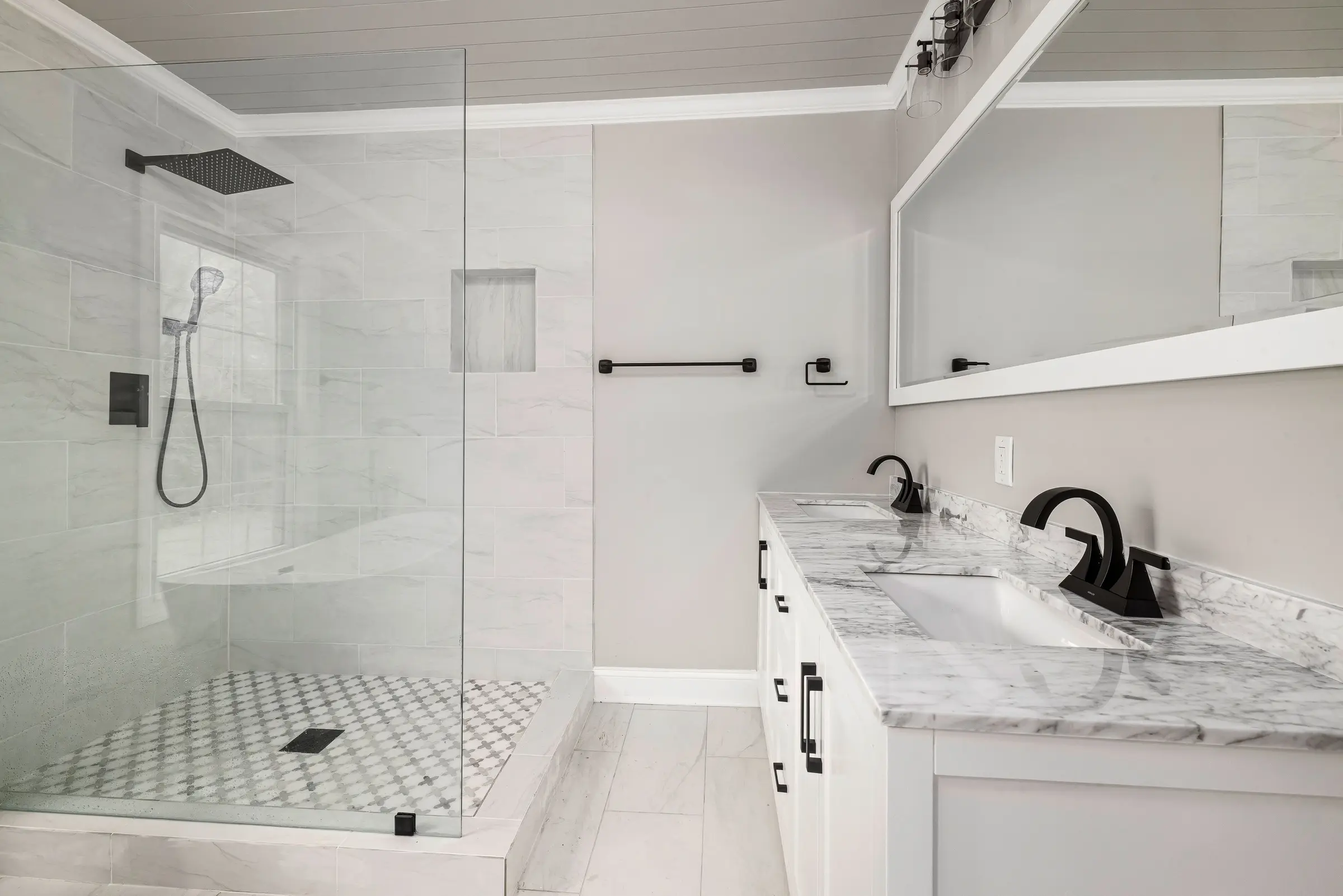
| Wheel-in shower | Named as an example in the 2015 budget, and used in its example of a wheelchair user's renovations. |
| Grab bars | Named in the 2015 budget. CRA's 2015 questions and answers say they would generally be a qualifying expense. |
| Non-slip flooring | Part of the couple's 2015 example, installed to reduce the risk of falling. |
| Ramp, wider entrance and interior doorways | Wheelchair ramps are named in the 2015 budget. The wheelchair user's example also has a wider entrance and wider interior doorways. |
| Tub-to-shower conversion, higher toilet, step-free entry | Not named in the 2015 budget or on CRA's current page. The two tests decide, and an accountant can say how they apply. |
Many bathroom jobs mix accessibility changes with ordinary upgrades. CRA lets you claim costs directly attributable to the qualifying renovation, and it excludes "the cost of renovation incurred mainly to increase or maintain the value of the dwelling." So ask for an itemised invoice that describes each item, and let your accountant sort the costs. Hiring a renovation contractor in Ontario covers what to ask for, and bathroom renovation cost covers the price side.
What counts as a cost, and what does not
CRA says eligible costs include paid work by a professional such as an electrician, plumber, carpenter or architect. If you do the work yourself, they include building materials, fixtures, equipment rentals, building plans and permits, but not the value of your labour or tools. Whether a job needs a permit is for the City: see permits in the Peterborough area.
CRA also excludes routine repairs and maintenance, household appliances, electronic home-entertainment devices, housekeeping and similar services, financing costs, and work from a person related to you unless that person is registered for GST/HST. CRA says assistance from the federal or a provincial or territorial government, including grants, forgivable loans and tax credits, does not reduce the credit. Ask an accountant how any other grant, such as one from a municipality, is treated.
Can you claim the medical expense credit too?
CRA's page for tax year 2025 says an expense that also qualifies as a medical expense can be claimed as both. That changed for 2026. Since January 1, 2026, an outlay that is included in computing the medical expense credit is not a qualifying expenditure for this credit. The rule is in the Income Tax Act, section 118.041, paragraph (k) of the definition of qualifying expenditure, added by the Budget 2025 Implementation Act, No. 1, S.C. 2026, c. 3, s. 42. CRA's note on the budget measure says a taxpayer can no longer claim both for the same expense. If your work is in 2026 or later, ask an accountant how the two credits apply to your costs.
Is there an Ontario or general renovation credit?
CRA's list of provincial credits and grants for homeowners, dated January 2026, names three for Ontario: the Northern Ontario energy credit, the Ontario energy and property tax credit and the Ontario senior homeowners' property tax grant. None is a renovation credit by name. For a secondary unit, a different federal credit exists: see the multigenerational home renovation tax credit.
What to keep, and what to ask first
CRA says to keep agreements, invoices and receipts, and not to send them with your return. They should identify the vendor or contractor and their address, describe the work and where it was done, show the date and amount, and show proof of payment in full.
Before you spend, ask an accountant:
- Who is the qualifying individual, and who is an eligible individual?
- Which costs relate to which change?
- How does this credit sit with a medical expense claim for your year?
For a bathroom renovation, Gilbert Brothers gives a free estimate at your home and a quote for the whole job before work starts. See bathroom renovations or get in touch.
Frequently asked questions
Does a walk-in tub qualify for the tax credit?
The 2015 federal budget named walk-in bathtubs as an example of an eligible expenditure. CRA's current page does not list qualifying items, so the two tests decide: a lasting part of the home, and a change that helps the qualifying person get in or move around, or lowers their risk of harm. Ask an accountant.
Can my adult child claim it for my bathroom?
CRA lets an eligible individual claim for a qualifying individual, and lists certain relatives. The conditions are detailed, so ask an accountant. The $20,000 limit is shared among everyone who claims for the same dwelling.
Can I claim it if I rent?
CRA describes an eligible dwelling as a housing unit owned by the qualifying individual or the eligible individual, and ordinarily lived in. Ask an accountant about your situation.