
How to Tell If Your Concrete Walkway in Peterborough Needs Replacing This Spring
- analytics403
- Apr 13
- 7 min read
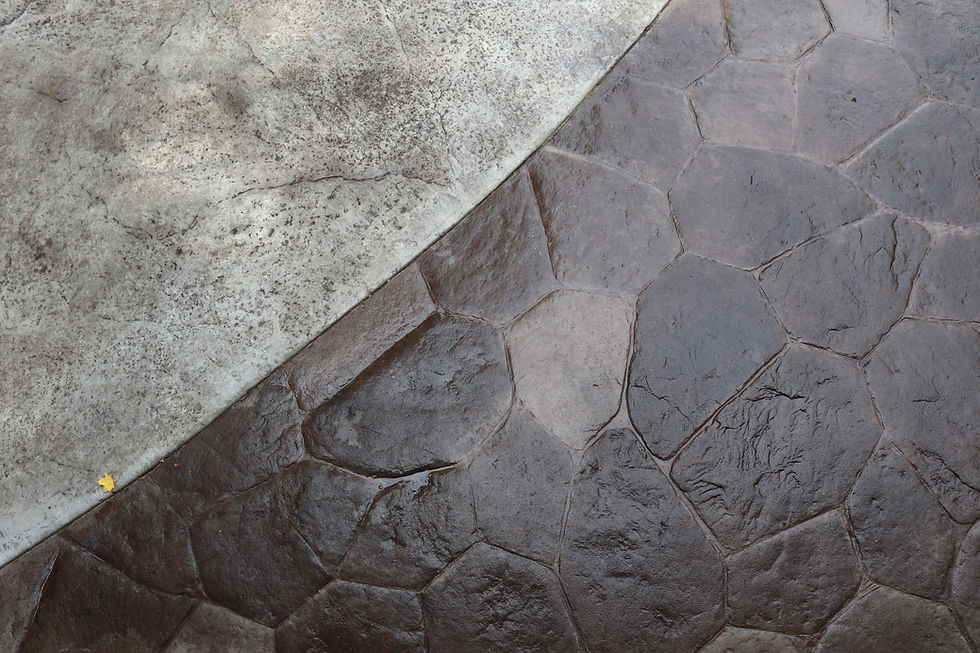
The snow pulls back in April and suddenly you're looking at your front walk for the first time in five months. If you've owned the house for a few winters, you already know the drill. The walk looks different than it did in October. A new crack somewhere. A section near the step sitting higher than the one beside it. Salt streaks you can't quite scrub out of the concrete anymore. Every spring the front walk tells on the winter, and the story this year is usually a little rougher than last year's was.
The question you're actually asking, even if you haven't said it out loud yet, is whether the slab is done or whether you've got another few years left before you deal with it. We'll be straight with you about that. Most of the damage people are looking at in April is already past the point where there's anything worth doing short of replacing the walkway. The cases where a slab can genuinely be brought back are rarer than homeowners expect, and they almost always involve cosmetic issues you can handle yourself with a sealer from the hardware store.
Here's how to tell which category your front walk falls into, and what to expect from the replacement process if the honest answer is that it's time to pour a new one.
What a Peterborough Winter Does to a Concrete Walkway
Concrete around here takes a beating homeowners in warmer parts of the country don't really think about. We're cycling between freezing and thawing dozens of times every season, and each cycle works the slab a little harder than the last one did. Water sneaks into a small surface flaw, turns to ice, expands, and opens that flaw a fraction wider. Do that forty or fifty times between November and April. Add road salt into the chemistry. What you end up with is a slab that's been getting chipped away at for months before anyone walking on it notices.
What shows up on the surface is a lagging indicator of what's already happened underneath. By the time a crack is wide enough to see from your front porch, the slab's been under stress for a while. Lifted joints and sunken sections are the same story told a different way. Those almost always trace back to the base moving, not to the concrete itself failing. Frost pushes into the soil, the soil shifts, and the slab goes wherever the ground decides to take it.
Once the base has moved, the slab on top of it has already lost the fight. You can't push a lifted section of walkway back down and have it stay there, because the problem isn't the concrete. The problem is whatever's happening in the ground underneath, and the only real fix is taking the slab out, correcting the base, and pouring new concrete on top of a foundation that's actually going to hold it.
The Difference Between a Cosmetic Issue and a Concrete Walkway in Peterborough That Needs Replacing
Not everything you see on a walkway in April is a real problem. There's a small category of damage that's genuinely cosmetic, and for those issues, the honest answer is that you probably don't need a contractor. Buy a good concrete sealer from any home improvement store in town, follow the instructions, and you'll be fine for another few seasons.
Cosmetic stuff a sealer handles on its own:
Fine hairline cracks that haven't widened since last spring and that you can barely fit a fingernail into.
Surface dusting or the washed-out, chalky look that road salt leaves behind after a long winter.
Light staining from leaves, tire marks, or whatever else the season left on the concrete.
Everything below is a different conversation. These are the signs of a walkway that's structurally done, and the only real answer for them is full replacement. Patching, grinding, resurfacing, or lifting methods might look like shortcuts on paper, but they don't address why the slab failed in the first place, and the problem comes back inside a season or two with the same damage showing up in the same places.
Signs you're looking at a concrete walkway in Peterborough that needs replacing, not repairing:
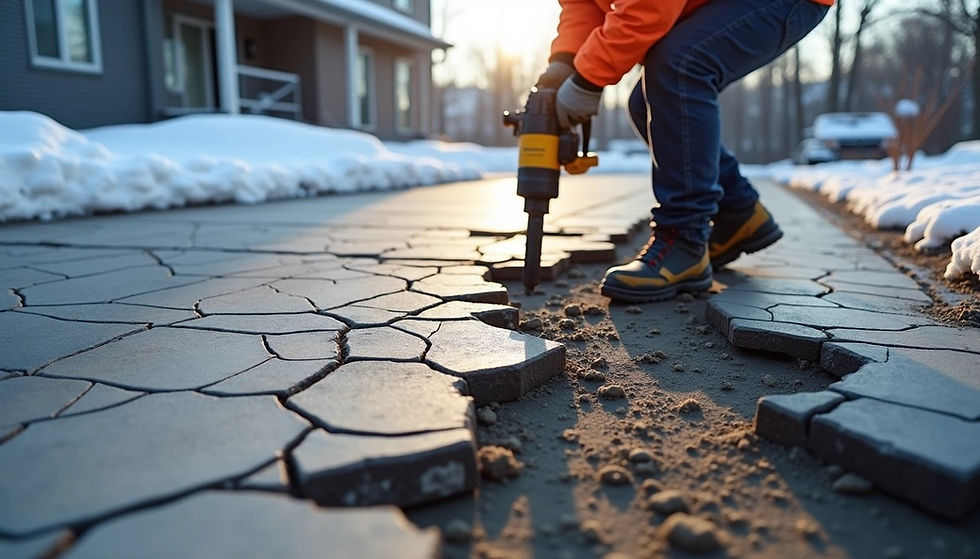
A section that's heaved or dropped by more than half an inch or so. The base under the slab has moved, and nothing you do to the concrete above it will hold if the ground underneath is still shifting.
A crack running the full width of the walkway with a visible lip between the two halves. That's not cosmetic anymore. That's the slab telling you it has failed, and no amount of surface work is going to change that.
Scaling or spalling across a meaningful portion of the walk. Once the top layer is coming off in chips or sheets, the concrete itself is breaking down, and there's no patching product that gets you back what you've already lost.
Puddles sitting where water used to run off. If the rain isn't draining the way it used to after a storm, the grade has shifted, and a shifted grade means the base has moved along with it.
Cracking or settling that pushes water back toward the foundation of the house. This one is less about the walkway itself and more about what the walkway has started doing to the building beside it. Worth dealing with sooner rather than later, and not with a tube of crack filler.
If you're seeing any of those, the walkway is telling you it's done. Putting money into temporary fixes on a slab that's already failed is the more expensive road by the time you're finished with it.
Why the Concrete Finisher in Peterborough You Pick Actually Matters on Walkways
Walkways get treated as easy jobs more often than they should, mostly because they're smaller than a driveway and less visible than a patio. But the details that separate a walkway holding up for twenty years from one starting to fail in five are almost all in the prep and the finish. Those happen to be the parts you can't see once the job is done, which is probably why they're the first things to get cut short on a rushed project.
A careful concrete finisher in Peterborough pays attention to a handful of things on a walkway job. None of them are obvious from the surface. All of them matter for how the slab ages.
The base. You want the right depth with the right granular material, and you want it compacted properly between lifts. Get any of that wrong and the slab above is going to move no matter how clean the pour looks on day one.
The grade. Water has to shed off the walkway without the surface feeling like it's tilting underfoot when you walk it. That balance is more feel than formula.
Control joints. Every slab cracks somewhere eventually. The job of a good finisher is to pick the spot ahead of time so the crack lands on the joint instead of across the middle of your walkway.
A finish texture that holds traction when it's wet. A perfectly smooth walkway photographs beautifully in June and becomes the slipperiest thing on the property every February after that.
None of that is complicated on its own. What matters is doing all of it, every time, because the corner that gets cut on a walkway is almost always the corner that comes back three winters later as the problem nobody wanted to deal with.
What the Concrete Removal and Replacement Process Actually Looks Like
If you haven't had concrete work done before, the process can feel more mysterious than it is. Here's the simple version of how a walkway project moves from the first phone call to a finished slab you can actually walk on.
Site visit and quote. An in-person look at the walkway and a conversation about what's going on with it, followed by a written quote with real numbers instead of a ballpark figure thrown out over the phone.
Removal of the old slab. Gilbert Brothers handles concrete removal services in-house, so the same company pouring the new walkway is the one taking out the old one. That keeps the whole job under one set of hands from demo through finish.
Base preparation. Granular base goes in, gets compacted to the right density, and the forms get set to the new grade. If drainage was part of why the original walkway failed in the first place, this is the stage where that gets corrected instead of poured over and forgotten.
The pour and the finish. The concrete gets placed and levelled, then finished to whatever texture was agreed on at the quote stage. Control joints get cut into the surface before the slab has fully set up.
Curing and sealing. The slab is left alone to gain strength for as long as it needs. Sealing happens once the concrete is actually ready for it, not before.
Most walkway projects run somewhere between a few days and about a week of active work depending on scope and weather. The pour itself is often a single morning tucked inside that window. The rest is prep and patience, and neither one of those can be rushed without it showing up in the finished slab later on.
Booking Your Concrete Walkway in Peterborough Before the Spring Schedule Fills Up
Spring moves fast in this trade. Walkway projects are smaller than driveways or full patio builds, which means they tend to get slotted into the gaps between the bigger jobs once the schedule starts filling in. Calling earlier in the season gets you a real say in when the work happens. Calling later usually gets you whatever slot is left at the end of the summer.
Gilbert Brothers is a concrete company in Peterborough covering walkways, patios, steps, shed pads, and concrete finishing, along with concrete replacement and removal across that same range of projects. We focus on new pours and full replacements rather than patchwork, because patchwork on a failing slab is the kind of thing that brings homeowners back to the same conversation a year or two later with more damage and a bigger bill. The work runs from the first consultation and design conversation through installation and the final pass of the sealer, with everything staying in one set of hands from start to finish.
If your front walk made it through this winter but you can already tell it isn't going to make it through another one, now's the right time to get it looked at properly. A quote costs nothing, and the conversation is genuinely the easiest part of the whole project. Reach out through the website or give a call, and by the time the lilacs are blooming along the front bed, the walkway leading up to your door could finally be the piece of the yard that looks the way you've been meaning to make it look for the last three summers.


Comments