
The Spring Backyard Checklist: Why Now is the Best Time to Plan Your Concrete Patio in Peterborough
- analytics403
- Feb 12
- 6 min read

Most people don’t start thinking about their backyard until the weather breaks. By then, it’s a scramble. If you’re a homeowner in Peterborough and a new patio has been on your mind, the planning should start now, while there’s still snow on the ground.
We say this from experience. Every spring at Gilbert Bros, the same thing happens. Late April rolls around and suddenly the phone doesn’t stop. Everybody wants their concrete patio finished before the May long weekend, and our schedule is already spoken for. The people who end up loving their finished project? They called us back in February. They had time to sort out exactly what they wanted, pick their finish, and get on the books before anything thawed.
So consider this your planning checklist. Not a sales pitch. Just a walkthrough of what’s worth thinking about right now so that when spring does arrive, you’re not starting from zero.
Why Booking a Concrete Contractor in Peterborough Early Actually Matters
Here’s the reality of working with concrete in this part of Ontario. You can’t pour when it’s cold. Nighttime temps need to hold above 5°C for the curing process to go right, and around Peterborough and the Kawarthas, that doesn’t happen reliably until mid to late April. The season wraps up around October. So that gives every concrete contractor in the region about six months to fit in all the driveways, patios, walkways, shed pads, and everything else people want done.
Six months sounds like a lot until you realize how many homeowners are all calling at the same time. And they are. The first warm Saturday in spring triggers a wave of quote requests that doesn’t let up until June.
Getting in touch during February or March puts you ahead of that wave. Practically speaking, it means:
You pick your timeline instead of taking whatever’s left. Front-of-the-line scheduling means your patio gets poured in May or early June, not crammed into a September slot because everything else was taken.
You actually get to think about what you want. We’ve seen homeowners rush into a layout because they felt the clock ticking, and then wish they’d done it differently once they’re sitting on it every evening. A few extra weeks of planning changes the outcome.
You get better access to materials. Some stamped concrete colours and patterns need to be ordered ahead. If your heart is set on a specific look, early is the way to make sure it’s available.
None of this is meant to create urgency for urgency’s sake. We just know, after doing this for years, that the best projects are the ones where nobody felt rushed.
Stamped Concrete Patterns That Work Well on Peterborough Homes in 2026
There’s a reason stamped concrete keeps showing up on patios across Peterborough. The cost is significantly lower than natural stone, the look is convincing, and when it’s sealed properly it handles our winters without issue. Freeze-thaw cycles are hard on a lot of materials. Stamped concrete, done right, isn’t one of them.
A few patterns have been standing out this year, and they tend to match well with what’s already built around here.
Ashlar Slate Stamped Concrete
Still the most requested. It’s a rectangular, staggered layout that reads as clean and traditional without being boring. Works on pretty much everything, from the older brick homes around East City to newer builds out in Otonabee-South Monaghan. The surface texture also gives it decent traction when it’s wet, which matters more than people think when you’re walking out with a plate of burgers in July.
Flagstone Pattern Stamped Concrete
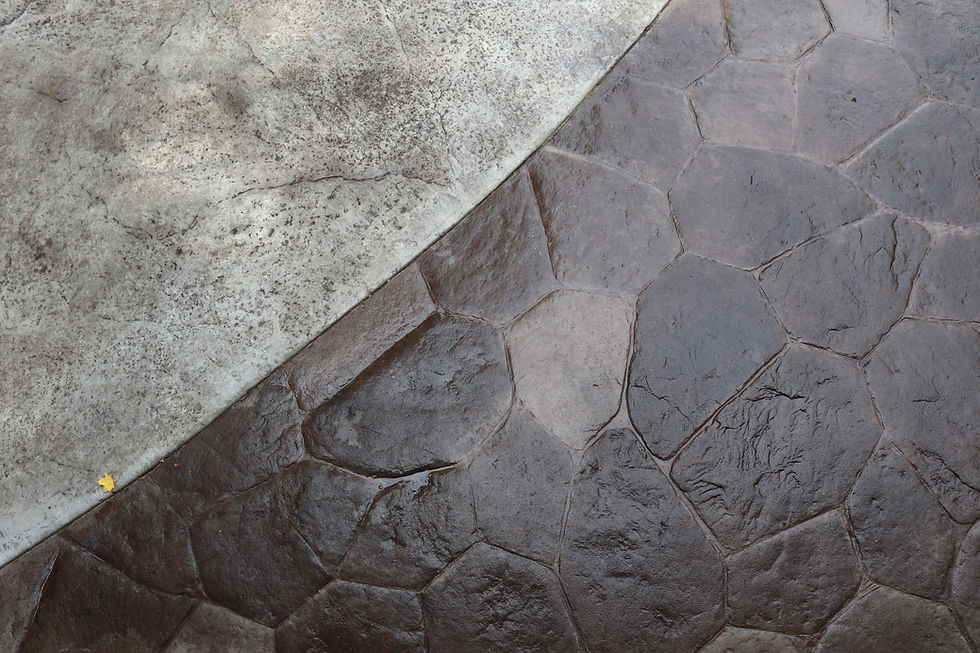
This is the one people gravitate toward when they want something that feels less structured. It mimics the look of individually placed stones, but you don’t deal with the weeds growing between joints or stones shifting and settling after a couple of winters. We install a lot of this on patios that border garden areas or transition into a wooden deck. The irregular shapes give it a relaxed feel that suits those kinds of spaces.
Large Ashlar Stamped Concrete for Contemporary Homes
Newer homes going up around the Chemong area or along the 115 corridor tend to have a more modern look, bigger windows, cleaner lines. A large-format ashlar stamp matches that style well. The oversized tile pattern feels current without being trendy, and it looks especially good in charcoal or slate grey tones. If your house was built in the last five to ten years, this is probably the direction worth exploring.
The reason to settle on your stamped concrete pattern and colour now, rather than later, is simple. You want time to hold a sample against your siding, look at it in different light, and actually sit with the decision. Once the truck shows up, you’re committed.
Your Concrete Patio Should Be the First Project in the Yard, Not the Last
This one catches people off guard, but it’s worth knowing: the patio needs to go in before the gardens, the fence, the sod, and the deck. Not after.
Why? Because a concrete patio is structural work. It requires excavation, grading, a compacted gravel base, and enough clearance for a truck and equipment to move in and out. If you’ve already planted beds along the house or had a fence installed right up to the lot line, we’re now working around obstacles. Sometimes that means pulling out things that were just put in. Nobody wants to pay for that twice.
When the concrete patio in Peterborough goes in first, the rest of the backyard naturally organizes around it:
Planting beds get shaped to follow the patio edges on purpose, instead of ending up with odd gaps where nothing quite fits.
Drainage is handled correctly from day one. A skilled concrete finisher grades the slab so water moves away from the house and off the surface. That protects the foundation, the concrete, and whatever you plant nearby.
If a deck is part of the plan, having the patio elevation locked in first lets the deck builder set their heights and transitions accurately. No guessing, no shimming later.
Electrical and lighting can be roughed into the layout before the pour. Running conduit under or alongside a slab is straightforward. Cutting into one after it’s cured is not.
The patio acts as the reference point for everything that comes after it. Your landscaper works off its edges. Your fence guy works off its elevation. Get this piece right first, and the rest of the yard comes together with a lot less friction.
From Concrete Removal to a Finished Patio: How the Whole Thing Actually Works
Probably the most common question we get is some version of, “I’ve got an old slab out there that’s seen better days. What happens to it?”
Short answer: we take care of it. A lot of older homes in Peterborough still have their original patio slabs, and after 20 or 30 years of frost cycles, they’re cracked, lifted, or sinking. Before new concrete can go down, the old stuff comes out. Our concrete removal services handle the full process, from breaking and hauling away the old material to prepping the site underneath. You’re not stuck calling three different companies to get one job done.
Here’s how a typical patio project moves from start to finish:
1. We start with a site visit and conversation. We come to you, look at the space, hear what you’re thinking, and go over options. Then we put a detailed quote together. If you’re reading this in February or March, this is the step you’d be at.
2. Old concrete comes out if needed. The existing slab gets broken up and hauled off. We inspect the ground underneath for drainage problems or soft spots and deal with anything that’s there before moving forward.
3. The base goes in. A properly compacted granular base is what keeps your patio from cracking or settling two years from now. This step doesn’t look glamorous, but it’s the one that matters most for long-term performance.
4. Forming and pouring. Concrete is placed, levelled, and finished to the correct grade. If you’ve gone with a stamped concrete finish, the stamps and colour hardener are applied while the surface is still fresh.
5. Curing and sealing. The slab sits for several days to cure. After that, a quality sealer goes on to protect against moisture, road salt, and sun. This is the step that keeps the surface looking good year after year.
Start to finish, the active work usually runs about one to two weeks depending on the scope. But the real advantage is in the planning that happens months before the first shovel hits the ground.
Lock In Your Spring 2026 Concrete Patio Quote in Peterborough Now
You’re already doing the thing most homeowners skip, which is thinking about this before April. That’s not a small thing. It’s the difference between choosing your project and settling for whatever fits.
If you want to get the ball rolling, reach out. We’ll have a straightforward conversation about what you’re looking for, what makes sense for your property, and what it’ll cost. No pressure, no gimmicks. Just a quote with real numbers you can plan around.
Gilbert Bros has been the go-to concrete contractor in Peterborough and the surrounding area for years. Stamped concrete patios, walkways, driveway replacements, concrete removal, full backyard rebuilds. We do it all ourselves, start to finish. No subs, no finger-pointing if something needs attention.
Give us a call or send a message through the website to get your Spring 2026 quote. Once the weather turns, spots fill quickly. The homeowners who plan early are the ones sitting on a finished patio by June.


Comments